
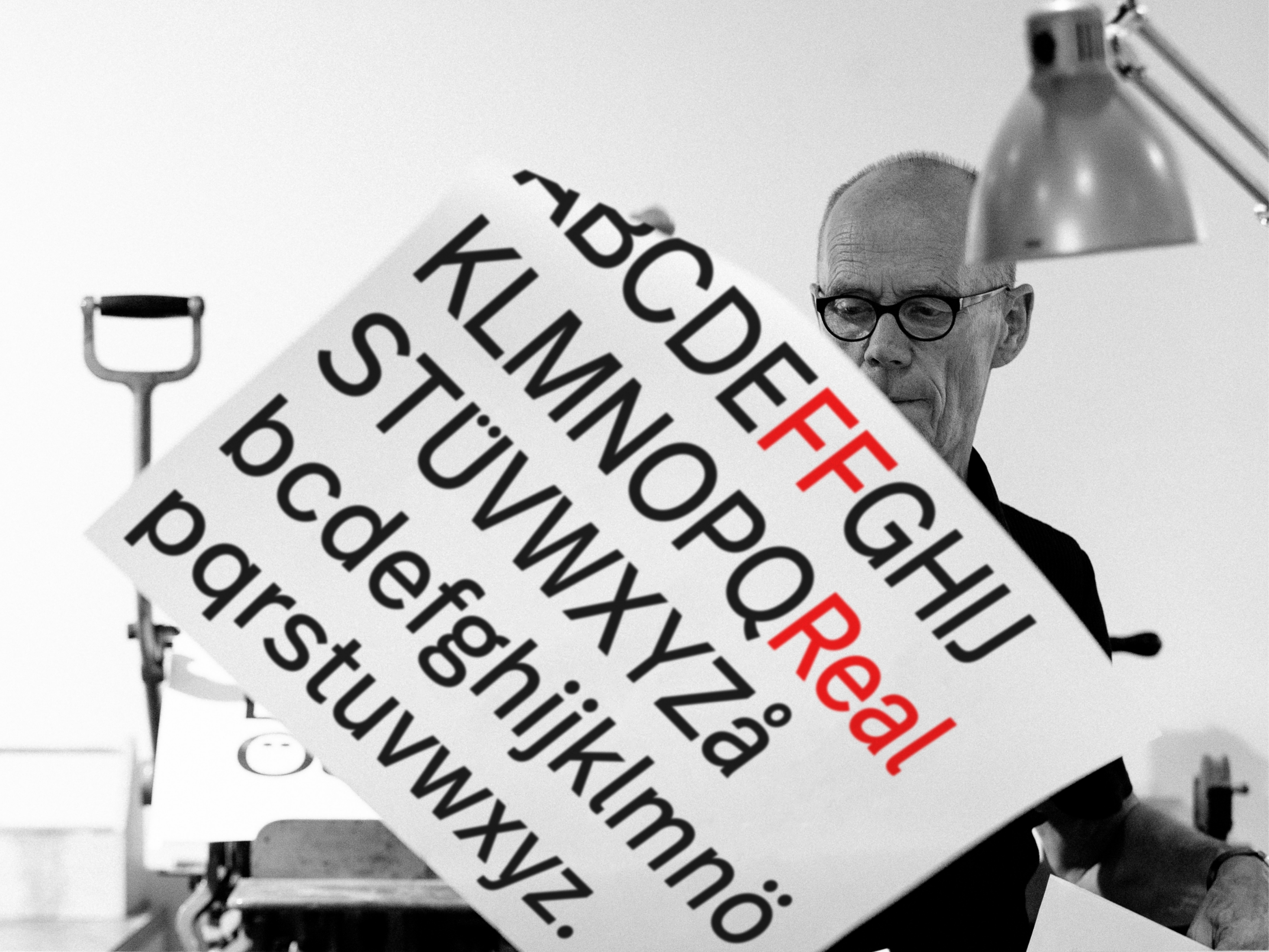

Long-time Applied collaborator, Partner, and resident design and type expert, Erik Spiekermann is a regular around our London studio. For decades, his work has shown that typography is both a craft and infrastructure for communication. It influences our ability to confidently navigate the world, empathise with brands and absorb information.
He kindly agreed to sit down with us, despite the 33°c heatwave in Berlin, and answer questions about life, letters and his latest project – ‘Hacking Gutenberg’, an experimental workshop dedicated to redefining letterpress printing in the 21st century.
It seems from the outside as though ‘Hacking Gutenberg’ is an evolution (or revolution) of your life’s work. Could you describe the project and your journey to this point?
I've always been close to words. Words and letters have always been my interest because that's how we communicate. It’s why I like languages. And obviously I like visual language, which is type.
In my early life I took an apprenticeship for a few years while I was still at grammar school. I was a quick learner. I got bored really quickly. I went straight from school when it finished at 1pm to my apprenticeship as a typesetter on the late shift at the newspaper.
In 1976, for some stupid reason, I packed my complete letterpress shop, borrowed an articulated lorry from a friend, and drove it to London. I set up in Notting Hill under a rundown railway arch. But this was short-lived. In 1977, June, the whole place burned down. There was nothing left. All the wood had gone up in flames. Even the metal type in my shop had melted. That finished that.
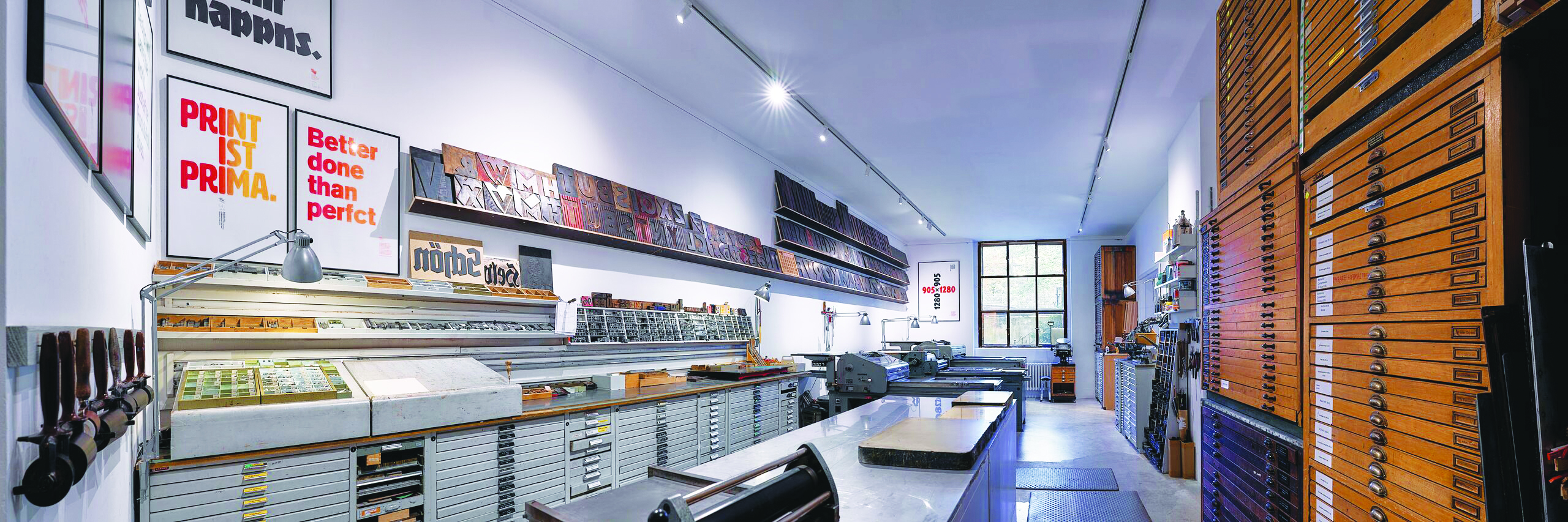
After working in design agencies and starting my own companies, I somewhat retired in 2013. I had started buying presses again and rented a studio space that I turned into a letterpress workshop in Berlin. I realised this goes beyond a hobby. The analogue way of working is what we are lacking. We are going backwards in evolution. We survived because we looked ahead and upright. Now we are looking down at our phones. We need to get out of our comfort and safe space on a screen to truly learn. We learn by touching things. We need to connect the intellectual and physical effort.
So, the mission. We call it ‘Hacking Gutenberg’ because we integrate old-fashioned machinery with technology. We combine traditional analogue equipment with digital capabilities – researching, printing, collecting, collaborating, publishing and making things in our Berlin workshop.
As it is, letterpress is not practical, it’s nostalgic and messy. In our workshops, people like the messiness, but I come from a professional background. I want things to look really clean and neat. So we print properly, we work with publishers to bring the quality and feel of real letterpress to new publications. We use laser setting to turn digital type into physical.
What was the greatest impact from Gutenberg’s work?
The dissemination of knowledge. If he hadn’t democratised words, texts, all the knowledge would have stayed with the scribes.
What are your top tips for not becoming a Luddite?
Don’t refuse something you don’t know about. Don’t call AI out and not know about it.
As a hobby it’s fine to hold on to the old way of doing things. I love people who maintain traditions, but to keep things truly alive, we need to understand where that knowledge comes from and how it applies to the world now.
Children who learn to write by hand are aware of the process. The more we are aware of the process, aware of the words, and the more we know how technology works, the more critical we can be of how the words and the tools are used against us.
You didn’t formally study design. At what point did you realise you were, or wanted to become, a designer?
If I’d wanted to become one I would have studied. I never learned it. I never went to design school, which is quite embarrassing to admit. But perhaps not anymore, as I think I've earned enough credits.
I got into it by solving other people’s problems. Really from then on people came to me because I was the ‘type’ guy. I became the fellow to go to. I had all this equipment and I sort of did design on the side because it was a quick way to earn money. One of my first jobs was making matchboxes, then brochures and leaflets.
I am good at the production part and the strategy. The artistic part of it doesn’t interest me so much. This is my strength. In solving problems and collaborating with people who are very good at what they do. I’m always thinking, how? Does it solve the problem?
In the world now, where creation knows almost no boundaries, what are the most important elements for producing good work or harnessing true creativity?
Take it apart. In your head, on the table. Realise what is missing. Examine what’s good, what’s bad. Add in what’s missing.
The best meals are when you are hungry and you throw them together with what you have. They aren’t perfect and you make do, but you enjoy the process of making. That’s where creativity and good work comes from.
Whatever a client brings is what there is. Clients have brands, elements, history, priorities. I might change the mix. Put something to the side, highlight elements. But I can’t reinvent them. My role is to make it work, feel good, look good.
Focus not on inventing, but reconstructing the pieces you have in front of you.
Contemporary design education has shifted from craftsmanship to digital tools in the past few decades, it is now shifting to AI. More design students and graduates are learning about AI and ‘creating something from nothing’, instead of traditional techniques, like letterpress or the practical elements of typographic design. What are your thoughts on this and how do you advise up and coming designers respond to this transition?
Students need to know more than we did fifty years ago. You need to know all the digital tools, but also you have to know about craft. I would make sure to have a good teacher who knows about AI, who knows about programming and coding, but don’t forget to feel things.
If you know you can do something with your own hands you understand the process and it makes you confident. Going back to craft is actually a way not to be overwhelmed by AI.
We can sense the digital s**t that is out there. We will lose humanity. Our world is physical because we are physical. We have hearts. We love our children. That is why the analogue is even more important than ever.
If you had to give your life over to be controlled by an LLM which one would you choose?
Claude. Anthropic seem to have the biggest sense of responsibility.
If you had to print forever in only one colour (not black) what would it be?
DayGlo red. I’ve always liked DayGlo.
Red was the second colour in manuscripts. It’s the colour of sealing wax. The colour of blood. Our hearts are red. Red roses are the expression of love. What can be better than red?
Who, or what, are you currently most inspired by?
Hmm, that’s difficult. There’s so much going on. I’ve started reading fiction again. Also, properly researched print publications. So maybe to summarise… good writing that takes you to another place!
Who, or what, has been the most consistent influence over your work?
There are so many people, but most of the people who influenced me growing up are dead. I have many loyal friends, my children and my wife.
But over this whole time. It’s letters on a page. The magic of that. That’s the one thing that has accompanied me over the years. Reading that touches me.
What beans are in your coffee machine right now?
I bought some yesterday. A kilo and a half. They are Arabica. I usually like a bit of Robusta.
I got them from a Lebanese coffee shop near my house. It’s a strong roast. If I didn’t get those I would get Sicilian roasted beans. I grind them at home and make coffee in a Moka pot. I need the real stuff. No milk. No sugar.
Thank you Erik for taking the time to answer our questions, for continuing to push the craft of typography forward, and for inspiring and mentoring our team.
Read more about Erik’s perspective, and his nearly eight decades of escapades, on his blog Spiekileaks.


